For years, the software development lifecycle (SDLC) followed a familiar pattern: gather requirements, design, build, test, release. Developers wrote the code, releases took weeks or months, and testing mostly happened near the end.
AI coding assistants have changed the speed of that cycle almost overnight. The question we hear most from other testers, and from founders, is simple: if AI can write the code and the tests, what's left for testers to do?
Our answer: more than before, but different work.
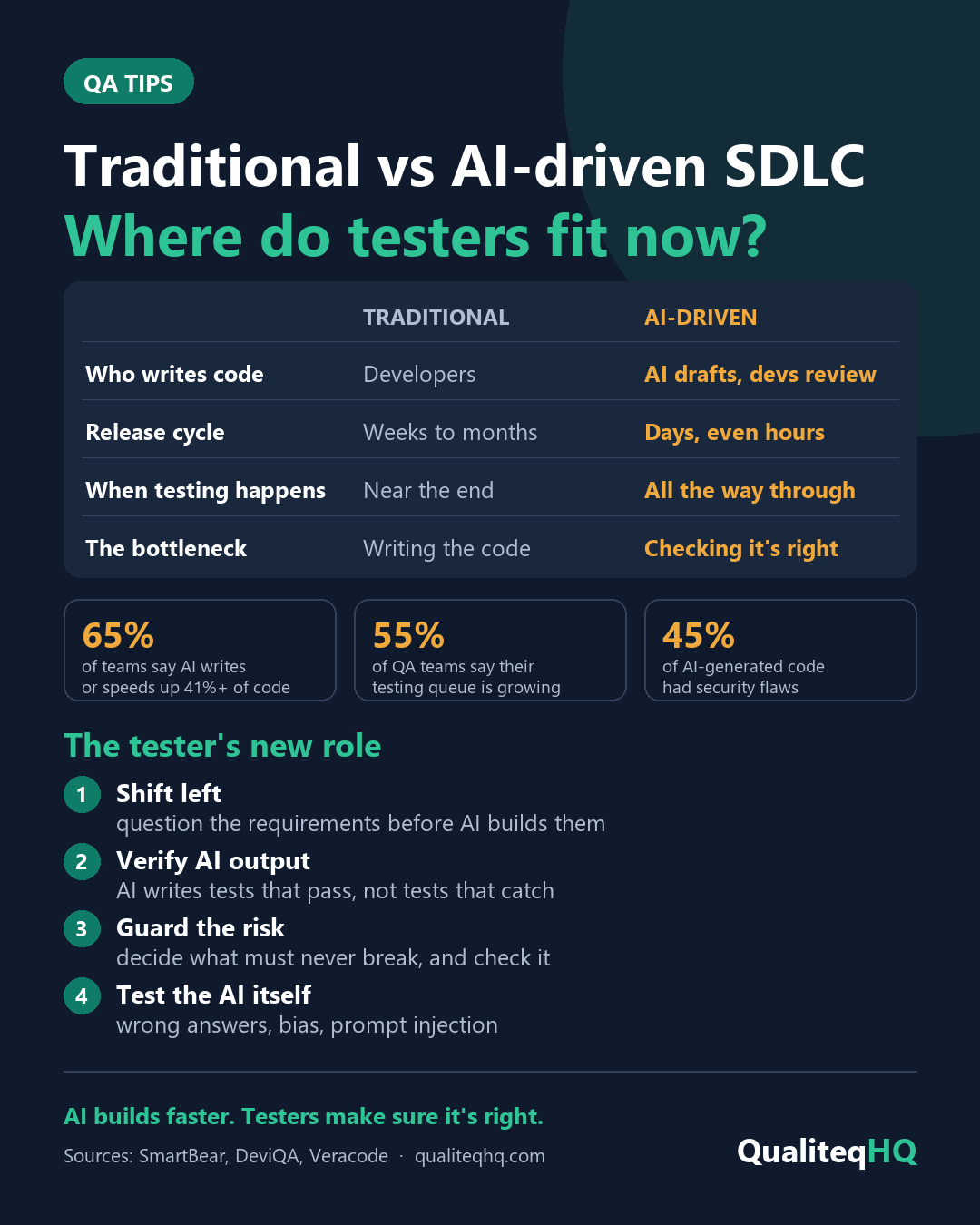
How the two lifecycles compare
| Traditional SDLC | AI-driven SDLC | |
|---|---|---|
| Who writes the code | Developers | AI drafts, developers review |
| Release cycle | Weeks to months | Days, sometimes hours |
| When testing happens | Mostly near the end | All the way through |
| The bottleneck | Writing the code | Checking the code is right |
The key change is the last row. When code is cheap to produce, the scarce skill is no longer writing it. It's knowing whether it does the right thing, safely, for real users.
What the 2026 data says
- AI is already writing a big share of code. In SmartBear's 2026 State of Software Quality report, 65% of respondents said AI writes or speeds up at least 41% of their code, and most aren't ready to take humans out of the loop.
- Testing queues are growing, not shrinking. In DeviQA's 2026 survey of QA professionals, 65% said features reach testing faster, 55% said their testing queue is growing and 52% are doing more retesting cycles.
- AI code still needs checking. In Veracode's tests across 80 coding tasks, 45% of AI-generated code samples contained security flaws.
Put together: AI moves the work downstream. More code arrives faster, and someone has to make sure it's right.
The tester's new role
-
Shift left
AI builds exactly what it's asked for, very quickly, including the wrong thing. Testers add the most value early, by questioning requirements, acceptance criteria and prompts before any code is generated. A missing edge case caught in a five-minute conversation saves a day of rework.
-
Verify AI output
AI can generate hundreds of tests in minutes, but a passing test isn't always a useful one. AI-written tests often check what the code does, not what it should do. Testers review generated tests and code for real coverage, meaningful assertions and the cases nobody prompted for.
-
Guard the risk
When releases happen daily, you can't test everything every time. Testers decide what must never break, like payments, logins and customer data, and make sure those journeys are covered by automated checks on every release.
-
Test the AI itself
Many products now include AI features: chatbots, recommendations, summaries. These need their own testing, for wrong or made-up answers, bias, unsafe output and prompt injection, where a user tricks the AI into ignoring its instructions.
AI builds faster. Testers make sure it's right. The teams that win with AI are the ones whose quality keeps up with their speed.
What this means for small teams
If you're shipping faster with AI tools, you don't need a large QA department. You need a few things in place:
- clear acceptance criteria before work starts
- automated checks on your most important user journeys
- a human review of anything touching payments, security or customer data
- exploratory testing before big releases
For more on what humans still do best, read 10 things AI still can't do in exploratory testing, or start with the software testing basics.
Sources
- SmartBear: The State of Software Quality and Testing 2026
- DeviQA: AI-Assisted Development 2026 Software Testing Report
- Veracode: AI-Generated Code Security Risks

Noel Aparece
Senior QA Engineer with 13+ years in software testing, ISTQB Certified Tester (CTFL) and co-founder of Qualiteq HQ.